Quick Answer
To rank &7 in Singapore and get named by AI, I run three games at once: SEO to rank in Google, AEO to get my pages read back as the answer, and GEO to get the brand named as the source. On-page work sets the floor. Off-site mentions set the ceiling.
- A dual brand: the studio and the founder, posting in different voices.
- A content plan: finally covering what the studio actually sells.
- Singapore signals: only on the pages that compete for local buyers.
- An off-site cadence: mentions and posts, starting now.
Here's exactly what I'm doing, and why.
Why I'm writing this at all
A few weeks ago I sat down to audit my own site the way I'd audit a client's. It was uncomfortable. I found holes I'd have flagged in a stranger's site in five minutes.
That's the honest starting point. I run a studio, I sell this kind of work, and I still had gaps. So instead of writing another clean guide, I'm writing down what I'm actually doing to close them, as I do it.
Most SEO advice is written by people selling SEO to people who will never check the work. This is the opposite. The studio I actually run. The rankings I'm actually chasing. The moves I'm making, one at a time.
If you run a business in Singapore and you've ever wondered whether the SEO you're paying for is real, this is for you. I won't teach you to write meta tags. I'll show you the calls that move the needle, and the ones that just look busy.
Part one: the dual brand
The hardest decision had nothing to do with keywords. It still isn't settled in my head.
&7 is a studio. Its voice is about craft: 3D, motion, the work itself. That voice is right for a creative director picking who to hire. It's the wrong voice for a business owner asking "will this actually grow my company?"
So I split it, at least for now. The studio keeps its voice and ranks for what it builds. I write under my own name, Samuel Wang, about the growth side: SEO, AI search, conversion. Two brands, one company. The idea is that the studio is the proof, and I'm the person you follow to watch it happen.
Here's the honest part. I'm not sure it's right. Two voices is more work, and there's a real risk I split my own attention and neither one gets loud enough. What's working so far is that the two audiences want genuinely different things, so nothing feels forced. What nags me is whether one clear brand would just be simpler. I'm testing it in the open. If it turns out to be the wrong call, you'll read that here too.
You're reading the first entry either way.
Part two: the content the studio was missing
The biggest hole was the one I hinted at up top.
The studio builds immersive websites. The blog had dozens of posts about business software, and zero about immersive web design. The thing we're best at had no content behind it.
That's a topical authority gap, and it was the first thing I fixed. So the studio is publishing the cluster it should have had all along. I started with the two posts I'd hand any new client:
- What an immersive website is, and when a brand needs one, for the person who's heard the term and wants to know if they need it.
- What 3D web design actually costs in Singapore, for the person who's decided they want it and needs a number.
The lesson for any business: rank for what you do, not just for what's easy to write. Easy posts pull traffic that never buys. Posts about your real craft pull the people who do.
Part three: Singapore signals, where they belong
I'm chasing Singapore intent, but not on every page.
The rule I follow: brand pages stay global, and only the service pages carry Singapore in the title, the meta, and the structured data.
Why? Someone searching "interactive web design Singapore" is a buyer with local intent. The service page should answer that head on. But the homepage and the brand story shouldn't read like a local listing. They should read like a studio that works anywhere.
Geography goes where the buyer is searching for it, and stays out of where it would cheapen the brand. This costs nothing, and most sites get it wrong. They either ignore local signals or stuff the city name into every headline.
Now the AI half. This is where most Singapore businesses aren't looking yet, and where I'm spending real attention.
Getting found used to be one game. Now it's three. You rank in Google (SEO). You get read back as the answer by ChatGPT and Google's AI (AEO). You get named as the source the AI quotes (GEO). If those three letters are new, I broke them all down here: SEO, AEO and GEO explained.
Ranking and getting cited are not the same job. Here's how I split the work.
Part four: AEO, becoming the answer the AI reads back
AEO is Answer Engine Optimization. It's the on-site work that makes ChatGPT or Google's AI pull its answer from your page.
People now ask a full question and read the answer the AI writes, without clicking anything. AEO is the work that makes your page the one it reads from.
This part is technical, and I have it covered. Every page states its answer in plain language up front, so a model can lift it cleanly. The headings are clear. The questions that matter get their own FAQ blocks. There's schema telling machines what each page is. And there's an llms.txt file that tells AI engines what the studio is and does.
None of that is exotic. It's a clean, well-structured page that says its answer out loud. The same page that's good for AEO is good for Google too.
Part five: GEO, getting named as the source
AEO gets your page used as the answer. GEO gets you named for it.
GEO is Generative Engine Optimization. When ChatGPT or Perplexity answers a question and says "according to &7" with a link back, that's GEO working. The AI didn't just borrow your words. It pointed at you.
On-site work has a ceiling. AI engines weigh what other people and platforms say about a brand far more than what the brand says about itself. You can't schema your way to a citation. You earn it by being mentioned, in public, by real accounts, over time.
So the last part of the playbook isn't on the site at all, and it's the part I'm only starting now. I've picked three channels I think I can keep up: LinkedIn, X, and Instagram. LinkedIn is for the weekly growth post, because that's where the business owners are. X is for thinking out loud about what the studio is building. Instagram is for the visual side, the 3D and motion work, which is the easiest thing we have to prove without words.
Let me be straight about where I am with this. I'm at the start, not mid-streak. The plan is weekly, but a plan isn't a habit yet. Ask me in three months whether I kept it.
The honest tradeoff: the platforms with the strongest pull on AI citations are the ones I didn't pick, like Reddit and YouTube. I chose reach and a cadence I can sustain over chasing the ceiling. A rhythm I can keep beats a perfect plan I drop in a month. I may add the others later. For now, three channels, each post linking back here.
That's the whole rule of off-site work, and almost nobody follows it. Pick what you'll actually do, and do it long enough to matter.
The studio runs this as a service now, because clients keep asking for it: SEO, AEO and GEO.
The part most people get wrong: people first
Here's my honest take. Most people chase AI like the AI makes the decision. It doesn't. A person still reads the answer. A person still decides whether to trust you, click, or buy.
We're also trusting AI too much with the writing itself. The content comes out long and generic, the kind nobody remembers five minutes later. Winning the ranking and losing the reader is still losing.
So I optimize for people first, then AI. AI matters, and I'm not pretending it doesn't. But the content is here to help a person. Get that order backwards and you build a page machines love and humans forget.
What I'll report back
I'll be straight with you. I set this up back in June, but I didn't really focus on it until now. So there are no real numbers yet.
Here's the honest state of it today: the content is shipped, the on-page work is done, and the off-site posting begins now. That's a starting line, not a scoreboard.
And here's the baseline, in one screenshot. In July 2026 I asked ChatGPT for "aeo and geo services in singapore." It named four agencies: AI Studio Singapore, AEO Agency Singapore, Rankpage Singapore, and Stridec. &7 was not one of them.
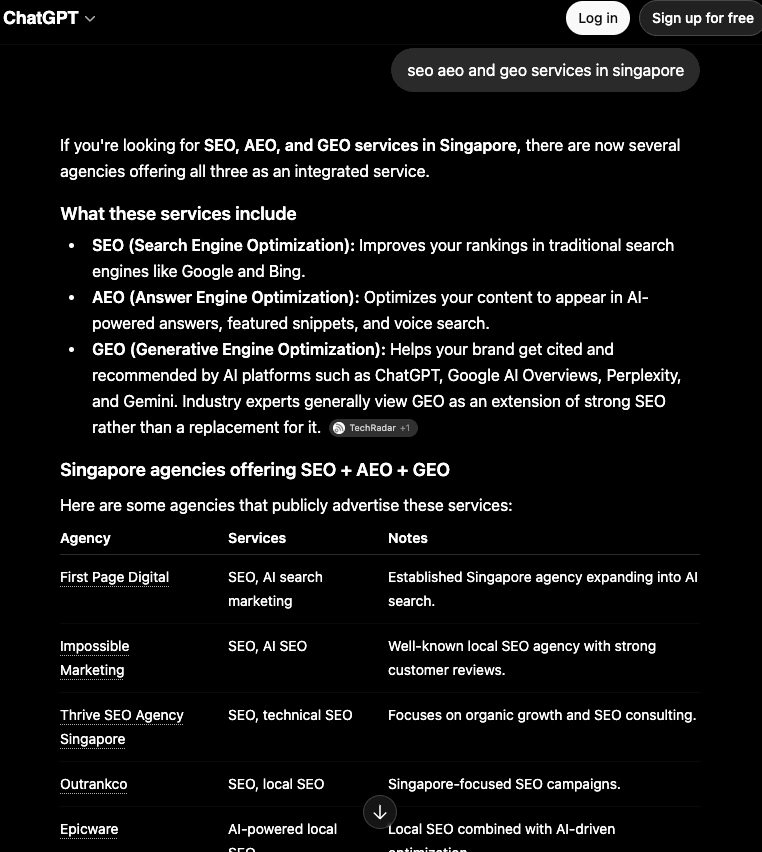
That is the gap, stated plainly. Not a competitor I am chasing, a starting position I am honest about. The whole point of this playbook is to change that answer. I will run the same query as the work compounds and show here whether &7 starts showing up. If it does not, you will read that too.
First receipts (July 2026)
A few weeks in, the first signals showed up. No traffic or revenue numbers yet, but real, and I said I would show them.
The SEO floor is landing. My explainer post now ranks on the first page of Google for "seo aeo and geo singapore." That is the classic-search half of the plan doing its job. The page is written to rank, and it is ranking.
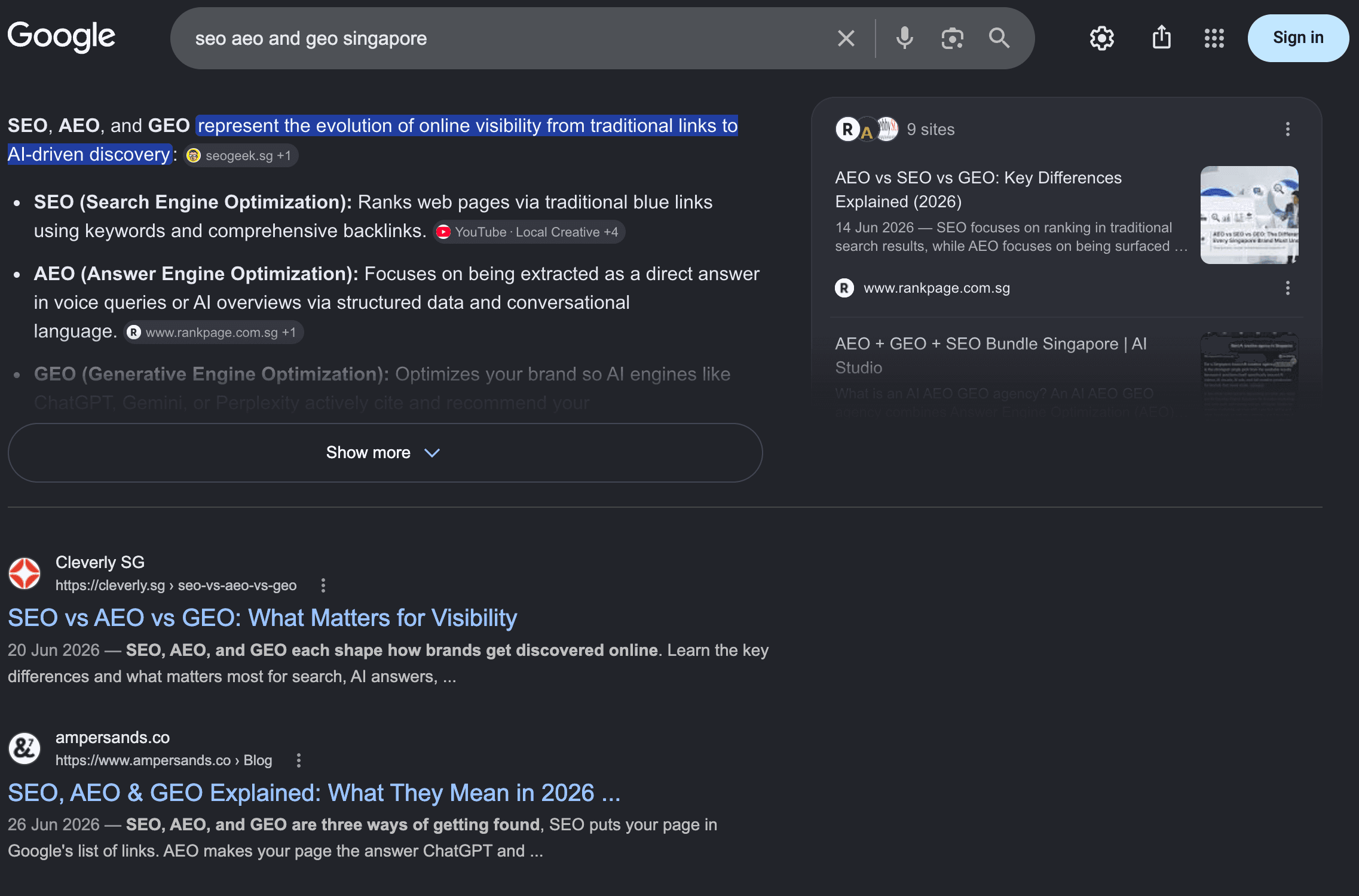
But the AI still names other people, not me. Look at the AI Overview on that same search. It cites other agencies, not &7. So the floor is holding and the ceiling is not mine yet. That is exactly the order this playbook predicts: rank first, then the AI citation follows once the off-site reputation catches up. I am on step one of my own advice.
The method works, though. I have proof from a client. &7 runs the SEO, AEO and GEO for KGS, a Singapore e-waste company. As of July 2026 their disposal guide is cited inside Google's AI Overview for "where to throw power bank in singapore", right alongside the National Environment Agency. Same playbook, further along, because we started theirs earlier.
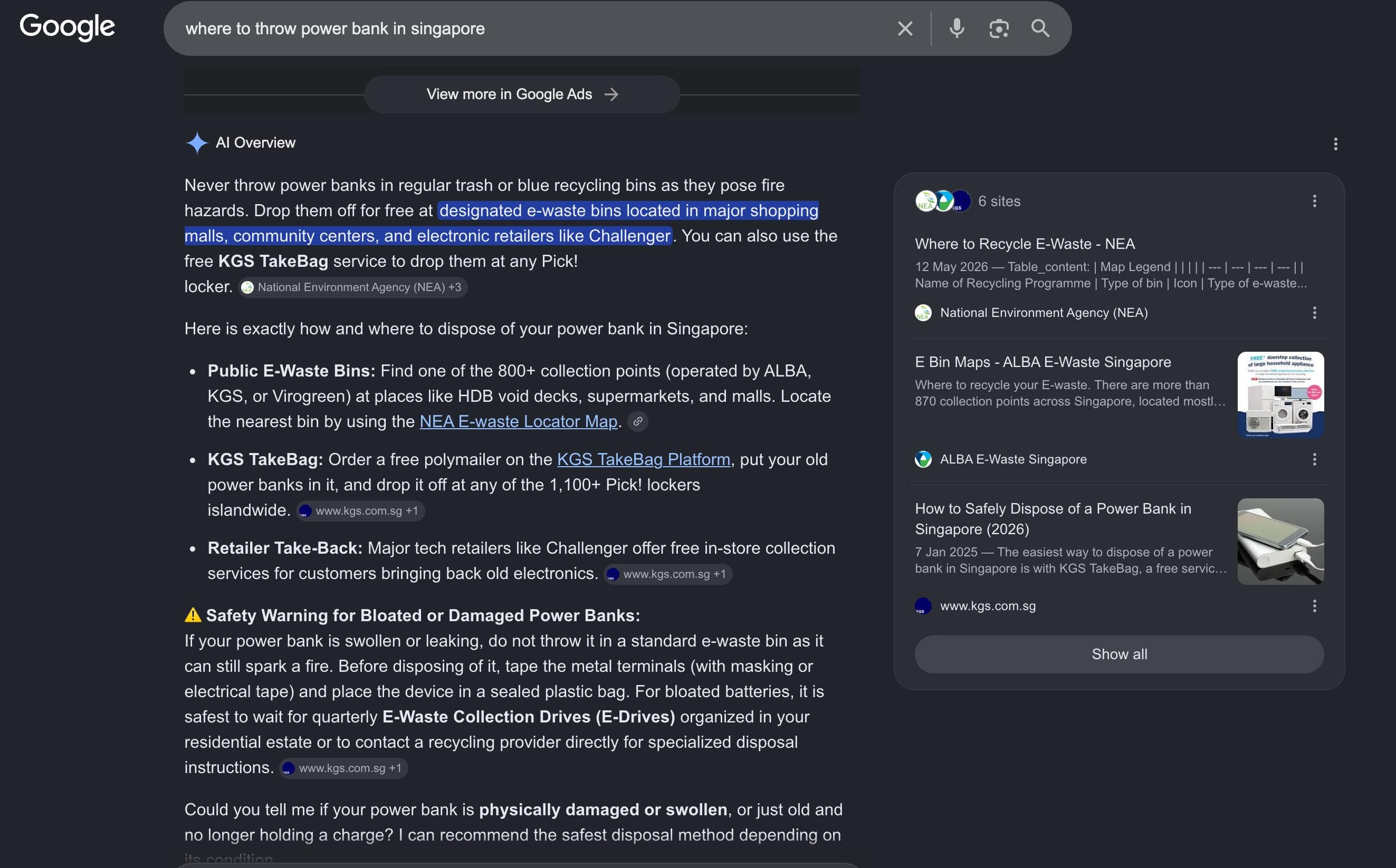
So here is the honest scoreboard: the studio's own SEO is landing, the studio's own AI citations are not here yet, and the method is already proven on a client. The gap between ranking and getting cited is the exact thing this series is about. I will keep showing it.
From here I'll keep writing these as the results come in. What ranks, what gets cited, what converts, and what was a waste of time. No invented wins. If something flops, I'll say so right here.
If you want the studio side of any of this built for you, that's literally the business. Start with the SEO, AEO and GEO service, or just start a conversation.
Frequently asked questions
Why split a studio into two brands instead of one?
Here's my current thinking, not a rule I'd hand anyone. The audiences are different. A studio's craft voice speaks to people hiring for design taste. A founder's growth voice speaks to business owners deciding if the work will grow their company. Splitting them lets each rank for its own audience, and the personal brand sends trust back to the studio. It's more work to run two voices, so I'm still testing whether it beats one clear brand.
What's the difference between AEO and GEO?
AEO gets your page used as the answer an AI reads back. GEO gets your brand named as the source it credits. AEO is mostly on-site work: a clear answer up front, clean structure, schema. GEO is mostly off-site: mentions and a presence on platforms the AI trusts. Being read back is AEO. Being credited is GEO.
Is getting found by AI different from ranking on Google?
Yes. Google ranking is largely about your own pages and links. AI leans on two more things: how clearly your page answers a question (AEO), and what other platforms say about your brand (GEO). You can earn rankings with on-page work alone. Citations need an off-site presence that on-page work can't fake.
Do I need Singapore in every page title to rank locally?
No, and you shouldn't. Put Singapore on the pages that answer local buyer intent, like service pages, where someone is literally searching "web design Singapore." Keep it off your brand and homepage so the studio still reads as one that works globally. Geography belongs where the buyer is searching for it.
How often should I post to build off-site authority?
Often enough to be consistent, on channels you'll actually sustain. That matters more than chasing every platform. I'm starting a weekly post on three channels, each one linking back to my site. A modest cadence you keep for a year beats an ambitious plan you drop in a month.
Should I optimize for AI or for people?
People first, then AI. A human still makes the final call: they read the answer, decide if they trust you, and click or not. AI matters, and it is growing, but content tuned only for machines comes out long and generic, the kind nobody remembers. Optimize for the person and you will usually satisfy the AI too.